

Image Details
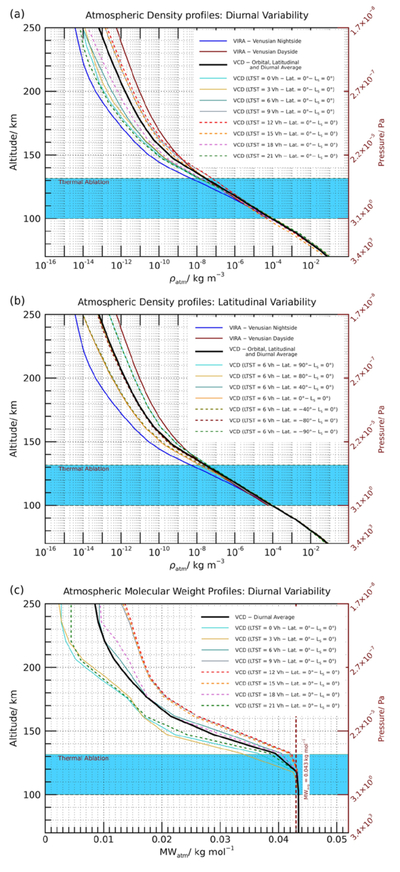
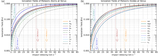
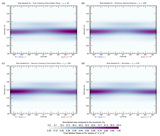
Caption: Figure 7.
Latitudinal (panel (a)) and diurnal (panel (b)) variability of the atmospheric density profiles as a function of the altitude, as predicted by the Venus Climate Database (VCD; S. Lebonnois et al. 2024). The black solid line represents the average atmospheric density profile adopted in the CABMOD–MIF model for Venus in this study, corresponding to the diurnal, latitudinal, and orbital average. The solid blue and red lines show the atmospheric density profiles for the midnight and noon hemispheres at the equator reported by G. M. Keating et al. (1985), based on measurements from multiple spacecraft, including the Pioneer missions and the Venera 11 and 12, between 250 and 100 km of altitude. Panel (c) shows the diurnal variability of the atmospheric molecular weight profiles as predicted by the VCD. The shaded blue region in these panels highlights the altitude range at which thermal ablation of meteors typically occurs in the upper atmosphere of Venus, for the sizes and velocities considered in this work. Note that the right y-axis in both panels illustrates the equivalent pressure levels, in pascals.
Other Images in This Article
Show More
Copyright and Terms & Conditions
© 2026. The Author(s). Published by the American Astronomical Society.

