

Image Details
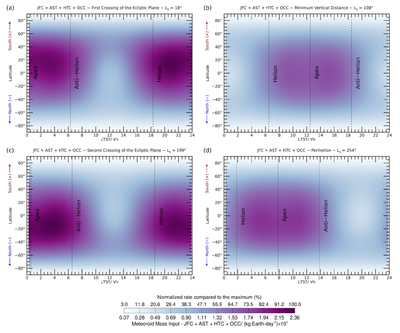
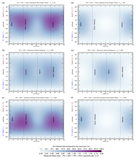
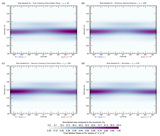
Caption: Figure 6.
Diurnal variability of the total mass influx of meteoroids, in kilograms per Earth-day, into the Venusian atmosphere before atmospheric entry, as determined by the MIF model for four orbital positions: the first crossing of the ecliptic plane (LS = 18°, panel (a)), the minimum vertical distance from the ecliptic plane (LS = 108°, panel (b)), the second crossing of the ecliptic plane (LS = 199°, panel (c)), and perihelion (LS = 254°, panel (d)). The LTST is computed assuming its corresponding value at longitude 0° (LTST0), that is, relative to the prime meridian at Venus. The vertical dashed black lines represent the positions of the antihelion, apex, and helion directions as a function of the LTST. An animation of this figure is available, showing the latitudinal and orbital variability of the total mass influx of meteoroids throughout Venus’ orbit; the animation cycles through all solar longitudes, starting from aphelion LS = 73°, going to LS = 0°, and then to LS = 74°.
(An animation of this figure is available in the online article.)
(An animation of this figure is available.)
The video/animation of this figure is available in the online journal.
Other Images in This Article
Show More
Copyright and Terms & Conditions
© 2026. The Author(s). Published by the American Astronomical Society.

