

Image Details
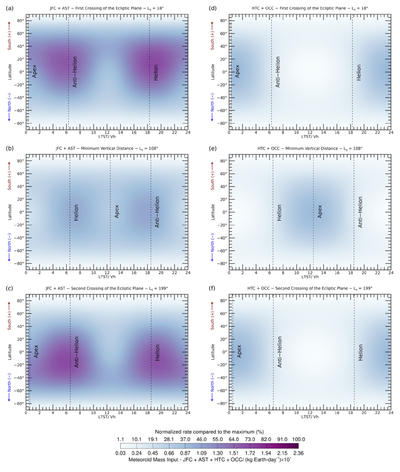
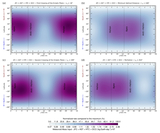
Caption: Figure 5.
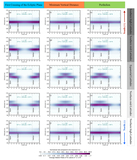
Diurnal variability of the mass influx of meteoroids, in kilograms per Earth-day, into the Venusian atmosphere before atmospheric entry, as determined by the MIF model for the combined contribution of the JFCs and the ASTs (panels (a), (b), and (c)) and the HTCs and OCCs (panels (d), (e), and (f)), and for three orbital positions: the first crossing of the ecliptic plane (LS = 18°, top panels), the minimum vertical distance from the ecliptic plane (LS = 108°, middle panels), and the second crossing of the ecliptic plane (LS = 199°, bottom panels). These distributions are presented as a function of the LTST, in Venusian hours (Vh), and the local latitude at Venus. The LTST is computed assuming its corresponding value at longitude 0° (LTST0), that is, relative to the prime meridian at Venus (defined by the central peak of the Ariadne crater at Sedna Planitia). The vertical dashed black lines represent the positions of the antihelion, apex, and helion directions as a function of the LTST. Note that the color scale corresponds to the overall mass influx after adding the relative contribution of the four meteoroid populations assumed in this work (see also Figure 6).
Other Images in This Article
Show More
Copyright and Terms & Conditions
© 2026. The Author(s). Published by the American Astronomical Society.

