

Image Details
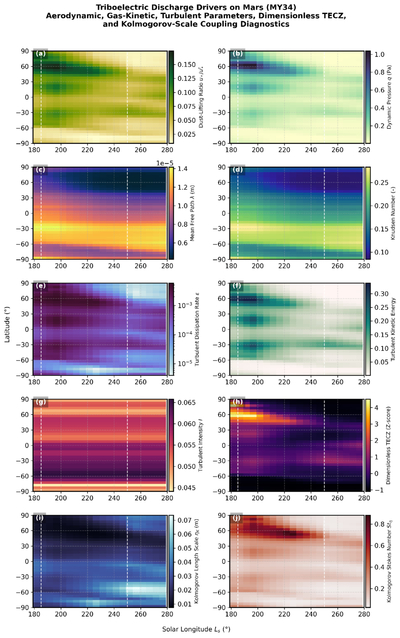
Caption: Figure 5.
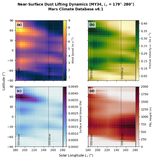
Latitude–solar longitude (Ls) evolution of aerodynamic, gas kinetics, turbulent, and triboelectric coupling diagnostics during the MY 34 global dust storm, derived from MCD v.6.1 fields. Panels show the (a) dust-lifting ratio ﹩{u}_{* }/{u}_{* }^{t}﹩, (b) dynamic pressure q, (c) molecular mean free path λ, (d) Knudsen number Kn, (e) turbulent dissipation rate ε, (f) TKE, (g) turbulence intensity I, (h) normalized triboelectric coupling index ZTECZ, (i) Kolmogorov length scale ηK, and (j) Kolmogorov Stokes number Stη. Vertical dashed lines indicate the approximate onset (Ls ≈ 185°) and decay (Ls ≈ 250°) of the storm. Enhanced triboelectric coupling occurs primarily where aerodynamic activation, continuum to near-continuum gas behavior, and intensified turbulence coincide, while the Kolmogorov-scale diagnostics indicate that storm-time strengthening extends down to the dissipative eddy scales relevant to particle clustering and collision-driven charging.
Other Images in This Article
Show More
Copyright and Terms & Conditions
© 2026. The Author(s). Published by the American Astronomical Society.

