

Image Details
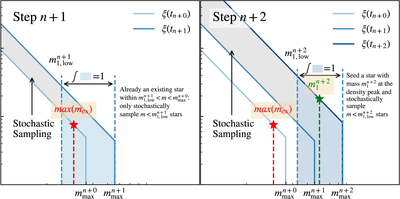
Caption: Figure 2.
Schematic illustration of the semideterministic (SDT) stellar mass sampling method. At each FoF time step n, the most-massive allowed star ﹩{m}_{1}^{n}﹩ is determined from the IMF ξ(m) such that exactly one star occupies the mass interval ﹩[{m}_{1,{\rm{low}}}^{n},\,{m}_{{\rm{\max }}}^{n}]﹩, where ﹩{m}_{{\rm{\max }}}^{n}﹩ is set by the instantaneous cluster mass ﹩{M}_{{\rm{ecl}}}^{n}﹩. Left panel (Step n + 1): if an existing star already lies within the updated high-mass interval ﹩{m}_{1,{\rm{low}}}^{n+1}\lt m\lt {m}_{{\rm{\max }}}^{n+1}﹩, no new massive seed is formed. Instead, only stochastic sampling is performed below ﹩{m}_{1,{\rm{low}}}^{n+1}﹩, drawing stellar masses from the inverse cumulative IMF with an upper mass limit of ﹩{m}_{1,{\rm{low}}}^{n+1}﹩. Right panel (Step n + 2): if no star occupies the high-mass interval ﹩{m}_{1,{\rm{low}}}^{n+2}\lt m\lt {m}_{{\rm{\max }}}^{n+2}﹩, a new most-massive star of mass ﹩{m}_{1}^{n+2}﹩ is seeded at the identified density peak of the RsvP group. The remaining mass reservoir is then populated through stochastic sampling below ﹩{m}_{1,{\rm{low}}}^{n+2}﹩.
Other Images in This Article
Show More
Copyright and Terms & Conditions
© 2026. The Author(s). Published by the American Astronomical Society.

