

Image Details
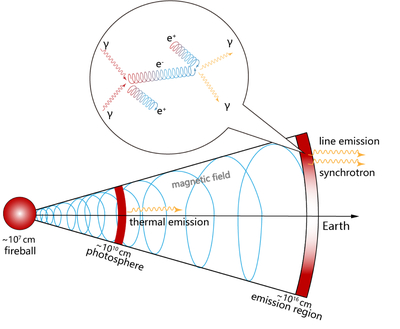
Caption: Figure 4.
Speculated schematics of the radiation processes in GRB 221009A. The central engine generates both a hot thermal component (fireball) and a cold component (magnetic jet). The fireball, with initial radius r0 ∼ 107 cm, expands and accelerates. A thermal emission with temperature of a few MeV, Tph ≃ 2 MeV, and luminosity similar to the fireball power, Lph ≃ Lw, is released at the photosphere radius ∼ 1010 cm when the fireball become optically thin but before the acceleration phase ends. The energy dissipation of the magnetic jet occurs at much larger radii, around ∼1016 cm, where the prompt nonthermal emission at ∼keV–GeV is generated by synchrotron or inverse-Compton radiation. The thermal emission energy is only a fraction of the nonthermal emission energy, which implies that the GRB jet is not dominated by thermal fireball energy but by magnetic field energy. In the same emission region, the γγ interactions lead to the production of e± pairs, which quickly cool by synchrotron radiation before annihilating each other into emission line photons. However, at lower latitudes, due to the weaker magnetic field and thus slower electron cooling, the line emission is much lower, which leads to the "rise-then-fall" profile of temporal evolution of the line flux.
Other Images in This Article
Show More
Copyright and Terms & Conditions
© 2026. The Author(s). Published by the American Astronomical Society.

