

Image Details
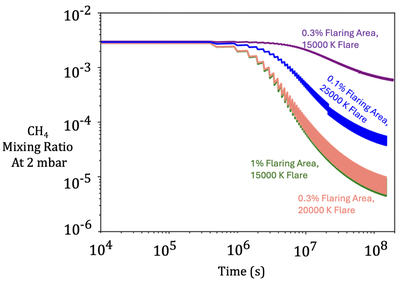
Caption: Figure 7.
The photochemistry reaches a new steady state of methane abundance as the star changes between quiescent and flaring conditions over time. VULCAN time-series results of methane mixing ratio at 2 mbar for flares with 20% frequency (105 s flares separated by 4 × 10⁵ s quiescent periods). Four cases are shown: 0.3% of the stellar area at 15,000 K, 0.1% of the area at 25,000 K (blue), 0.3% of the stellar area at 20,000 K (peach), and 1% of the area at 15,000 K (green). Repeated stellar flares can explain the missing methane at V1298 Tau b, and the magnitude of depletion is sensitive to the frequency and energy of the flares.
Other Images in This Article
Show More
Copyright and Terms & Conditions
© 2026. The Author(s). Published by the American Astronomical Society.

