

Image Details
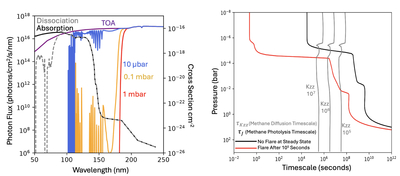
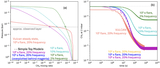
Caption: Figure 6.
Illuminating the key physics underlying the atmospheric mixing ratio profiles: the competition between photolysis and diffusion. Photolysis rates are determined by cross section and photon flux available at each level in the atmosphere after accounting for scattering and absorption (actinic photon flux). (left) Actinic photon flux at different levels of the atmosphere (top-of-atmosphere, TOA, in purple, 10 μbar in blue, 0.1 mbar in orange, and 1 mbar in red). These are compared with the CH4 cross sections (cm−2) for absorption (black) and dissociation (dashed gray). Cross sections are shown on the y-axis on the right side of the figure (right). Profiles of the CH4 photolysis reaction rate coefficients, J (s−1), for methane dissociation from (black) quiescent no-flare conditions to steady state and (red) after a 105 s flare. The gray lines intersect the red and black ones where diffusion is competing with photolysis. Above the intersection, photolysis is faster, and below the intersection diffusion is faster.
Other Images in This Article
Show More
Copyright and Terms & Conditions
© 2026. The Author(s). Published by the American Astronomical Society.

