

Image Details
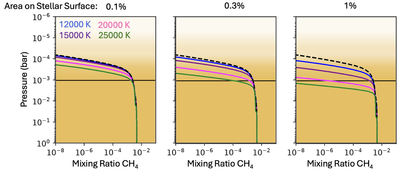
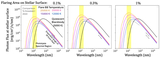
Caption: Figure 5.
Impact of different stellar flare temperatures and areas in single-flare events on the atmospheric methane abundance profile. Panels left to right show different flare sizes (fraction of area on the stellar surface): 0.1%, 0.3%, and 1%. In each panel, the quiescent steady-state result is shown as a black dashed line. We initialize all flare cases to this steady-state result, and then we change the stellar spectrum to the corresponding flare model and run VULCAN for 105 s. Flare temperatures of 12,000 K (blue), 15,000 K (purple), 20,000 K (magenta), and 25,000 K (green) are shown in each panel. Observations probe close to 1 mbar, shown as a horizontal black line. The background of each panel is shaded such that the greater opacity (below approximately 1 mbar) is where the atmosphere is opaque to observations. Above the black line at 1 mbar, the opacity of the shaded orange box decreases to depict the diminishing optical depth of the atmosphere. From these panels, we can see that single-flare cases that deplete methane to levels consistent with the JWST observations include: 0.1% fractional area and 25,000 K; 0.3% fractional area and 15,000 K and 20,000 K; 1% fractional area and 15,000 K. Cases with larger flares overdeplete the methane compared to the data.
Other Images in This Article
Show More
Copyright and Terms & Conditions
© 2026. The Author(s). Published by the American Astronomical Society.

