

Image Details
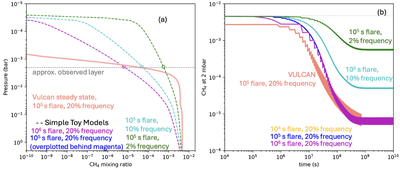
Caption: Figure A2.
Testing methane depletion for different flare frequencies and durations in the toy model. Steady-state mixing ratio profiles of CH4 are shown from the toy model for 106 s flares with 20% frequency (magenta), 105 s flares of 20% frequency (blue; overplotted and exactly matches the magenta profile); 105 s flares with 10% frequency (light blue); 105 s flares of 2% frequency (green). For comparison, the full photochemical result from VULCAN for 105 s flares with 20% frequency is shown in peach (this is the same flaring scenario as the toy model’s blue profile). In VULCAN, in the lower atmosphere (below the observed layer), fast reactions to restore the methane under high temperatures contribute to maintaining a nearly constant methane profile. Near the observed layer, photolysis and diffusion compete, making the toy model a good assumption. Above the observed layer, methane is destroyed faster in VULCAN by reactions with atomic H (but the toy model ignores these reactions). So, the toy model results only reproduce the full photochemical model well near the observed layer where diffusion and photolysis are the main drivers of the methane sources and sinks.
Other Images in This Article
Show More
Copyright and Terms & Conditions
© 2026. The Author(s). Published by the American Astronomical Society.

