

Image Details
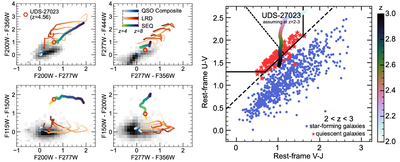
Caption: Figure A1.
Photometric selection biases induced by SEQ-like extinction. Left: A set of illustrative JWST/NIRCam color–color diagrams demonstrating that UDS-27023 (red symbol) lies outside common loci for AGN and QSOs in multiple color spaces. Colored tracks show synthetic colors for an intrinsic QSO composite (J. Selsing et al. 2016), representative LRD-like colors (Z. Zhang et al. 2025), and the SEQ extinction model, evaluated as a function of redshift (color coded). The gray background indicates the distribution of field sources from the JADES survey (B. E. Robertson et al. 2026) in the same diagrams. Right: UVJ diagram adapted from Figure 2 of A. C. Carnall et al. (2020), illustrating possible misclassification of SEQ under an incorrect low-redshift interpretation. We overlay the inferred UVJ track of UDS-27023 when forced to z = 2–3 (color coded by assumed redshift) in galaxy-only SED fitting. It falls within the standard UVJ-quiescent selection region (within black solid lines), consistent with its previous identification as a candidate of a z ≈ 2.5 quiescent galaxy.
Other Images in This Article
Copyright and Terms & Conditions
© 2026. The Author(s). Published by the American Astronomical Society.

