

Image Details
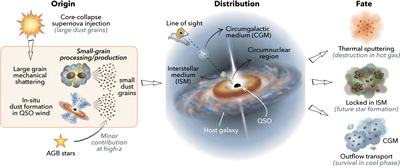
Caption: Figure 4.
Schematic illustration of the origin, distribution, and fate of small dust grains in the SEQ. Left (origin): In the early Universe, dust is predominantly injected as large grains by CCSNe, with minor contributions from AGB stars. Small grains may then be produced through two rapid channels in the QSO environment. In the first pathway, violent feedback drives grain–grain collisions, mechanically shattering large grains into small fragments. In the second pathway, silicate grains may condense in situ within dense QSO-driven winds. Middle (distribution): The JWST line of sight probes through the circumnuclear region, the host galaxy’s ISM, and the CGM, directly detecting the steep extinction signature of an abundant small-grain population against the background QSO continuum. Right (fate): These small grains face three primary evolutionary pathways. They may be destroyed via thermal sputtering in hot, shock-heated gas; they may remain locked in the ISM to facilitate subsequent molecular-cloud and star formation; or they may be entrained in cool-phase outflows and transported to the CGM, populating the extended, small-grain-rich halos recently observed around massive galaxies at high redshift.
Other Images in This Article
Copyright and Terms & Conditions
© 2026. The Author(s). Published by the American Astronomical Society.

