

Image Details
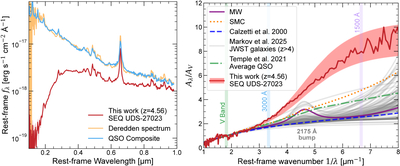
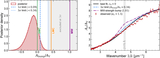
Caption: Figure 2.
Rest-frame SED and inferred line-of-sight extinction curve of UDS-27023. Left: rest-frame UV/optical/NIR spectrum of UDS-27023 (red) compared to an intrinsic blue-QSO composite (blue). The orange curve shows the spectrum corrected using the best-fit extinction curve, illustrating that the dereddened continuum approaches the intrinsic QSO template over the wavelength range. Right: extinction curve reconstructed for UDS-27023 shown as Aλ/AV versus wavenumber (1/λ; thick red curve), with the shaded red band indicating the corresponding best-fit parametric extinction model with uncertainty. For comparison, we plot the Milky Way and SMC extinction curves, the D. Calzetti et al. (2000) starburst attenuation law, the average QSO extinction curve (M. J. Temple et al. 2021), and the set of attenuation curves measured for JWST galaxies at z > 4 by V. Markov et al. 2025 (thin gray curves). Vertical shaded bands mark the V band and rest-frame 3000 Å and 1500 Å; the location of the 2175 Å bump is indicated for reference. The SEQ extinction curve rises substantially more steeply into the UV than any of these commonly used laws.
Other Images in This Article
Copyright and Terms & Conditions
© 2026. The Author(s). Published by the American Astronomical Society.

