

Image Details
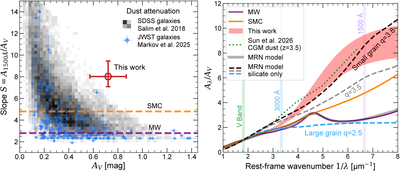
Caption: Figure 3.
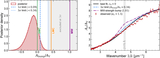
Physical interpretation and context for the steep extinction toward UDS-27023. Left: location of SEQ (red symbol) in the plane of dust-law steepness, S ≡ A1500/AV, versus AV. The gray-scale background shows the distribution of dust attenuation slopes inferred for Sloan Digital Sky Survey galaxies from the GSWLC survey (S. Salim et al. 2016, 2018), and the blue points show the z ≈ 2–10 JWST galaxy attenuation constraints from V. Markov et al. (2025). Horizontal dashed lines indicate the values expected for standard Milky Way and SMC extinction curves, illustrating that SEQ lies at significantly larger S than both typical low- and high-redshift galaxy extinction and attenuation laws at moderate AV. We note that this work (red point) provides a line-of-sight extinction measurement toward an unresolved point source, whereas the gray and blue distributions are attenuation constraints for spatially extended galaxies; the two are not strictly commensurable, and the comparison should be read in that light (Section 4). Right: comparison of the SEQ extinction curve (red band; normalized at V band) to common empirical laws (Milky Way and SMC) and to illustrative MRN grain-size models (J. S. Mathis et al. 1977) computed from optical properties of silicate and graphite (B. T. Draine & H. M. Lee 1984; A. Laor & B. T. Draine 1993; J. C. Weingartner & B. T. Draine 2001). The gray curves show an MRN-like size distribution (dn/da ∝ a−3.5) with a standard silicate+graphite mixture (solid) and silicate-only dust (dashed). Colored curves demonstrate how varying the size-distribution slope q (defined by dn/da ∝ a−q) changes the UV rise; small-grain–weighted distributions (larger q) produce substantially steeper far-UV extinction than large-grain/gray cases (smaller q). The green dotted line denotes a CGM dust extinction curve with a steep slope (F. Sun et al. 2026) at z = 3.5. Vertical bands mark rest-frame 3000 and 1500 Å and the V band. Together, these panels show that SEQ probes an extreme, line-of-sight extinction law, qualitatively consistent with a dust population strongly weighted toward small grains.
Other Images in This Article
Copyright and Terms & Conditions
© 2026. The Author(s). Published by the American Astronomical Society.

