

Image Details
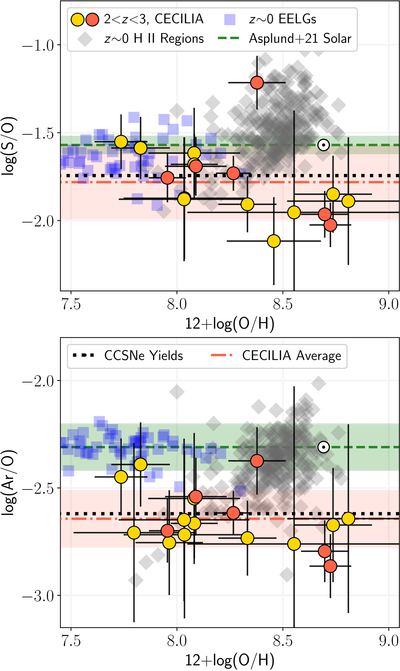
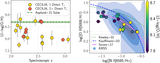
Caption: Figure 8.
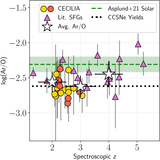
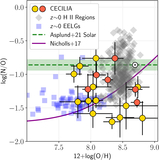
Direct abundance trends of S/O (top) and Ar/O (bottom) vs. 12 + log(O/H) for the CECILIA galaxies. Shape and coloring of the data are similar to Figures 5 and 6. The solar abundance ratio from M. Asplund et al. (2021) is represented as the circled dot and dashed green line with shaded area. The red dashed–dotted line and shaded area represent the average S/O and Ar/O abundance ratios and their uncertainties, respectively, from the full CECILIA sample. The dotted black line is the abundance ratio predicted from metal-poor CCSN yields of C. Kobayashi et al. (2006). Consistent with the abundance trends in D40 (N. S. J. Rogers et al. 2024) and other high-z galaxies, S/O and Ar/O are significantly subsolar in the typical SFG at Cosmic Noon. This abundance pattern is expected for a galaxy with significant CCSN enrichment, with minimal Type Ia contributions owing to the abbreviated SFH at z > 2.
Other Images in This Article
Show More
Copyright and Terms & Conditions
© 2026. The Author(s). Published by the American Astronomical Society.

