

Image Details
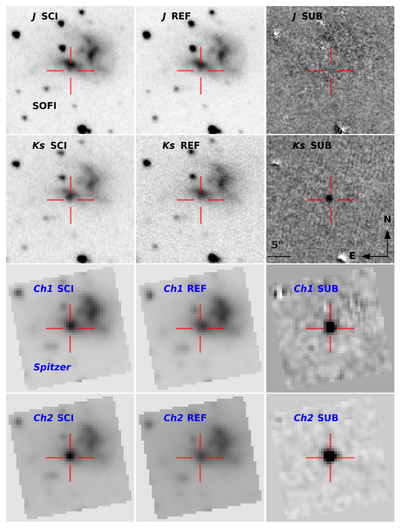
Caption: Figure C2.
SOFI and Spitzer images of SN 2018bsz and template subtractions. The first row illustrates the SOFI J-band frame taken on +266 days, the reference image taken on +599 days, and the difference between the two (with a 3σ detection limit of >21.92 mag). The second row shows SOFI Ks-band images as the same epoch as in the first row. The Ks-band subtraction clearly detects a source at +266 days, where we detect the SN at 19.65 ± 0.15 mag. The third row displays the Spitzer Ch1 (3.6 μm) frame taken on +384 days, the reference image taken on +565 days, and the result of their subtraction with a SN detection at 20.17 ± 0.24 mag. The fourth row presents the Spitzer Ch2 (4.5 μm) images, at the same epoch as in the third row, where the SN was detected at 19.13 ± 0.09 mag. Each panel has the same scale and orientation as marked in the second row.
Other Images in This Article
Show More
Copyright and Terms & Conditions
© 2026. The Author(s). Published by the American Astronomical Society.

