

Image Details
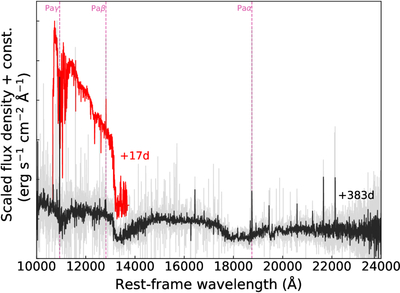
Caption: Figure B1.
NIR spectra of SN 2018bsz. We extracted the SN position in the SINFONI data cube obtained at +17 days. A narrow Paβ is clearly detected, which is from the host H II region. No broad emission from the SN has been seen, confirming the hydrogen-poor ejecta at peak brightness. The X-Shooter spectrum was taken on +383 days; no trace from the SN has been detected. The spectra shown in this figure are provided as Data behind the Figure.
(The data used to create this figure are available in the online article.)
(The data used to create this figure are available.)
Other Images in This Article
Show More
Copyright and Terms & Conditions
© 2026. The Author(s). Published by the American Astronomical Society.

Copyright ©
2026 Astronomy Image Explorer. All Rights Reserved.
