

Image Details
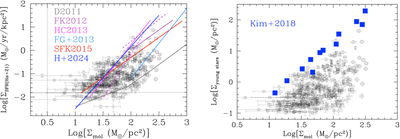
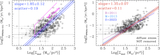
Caption: Figure 11.
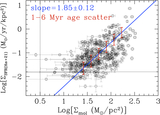
(Left) The SFR surface density as a function of the molecular gas surface density for our star-forming regions (black circles with 1σ uncertainties) compared with models. “Local,” multifreefall models shown include the central ridge of the multifreefall model by (C. Federrath & R. S. Klessen 2012, FK2012) for net efficiency ϵ⋆ = 0.01 (solid purple line) and 0.10 (dashed purple line); approximate linear tracks for the multifreefall model of P. Hennebelle & G. Chabrier (2013, HC2013) using the authors’ examples for clump sizes of 5 pc and maximum fraction of cloud size for deriving SFR yout = 0.25: isothermal model (solid magenta line) and nonisothermal model (dashed magenta line); and the sonic Mach number-based model by D. M. Salim et al. (2015, SFK2015) (red solid line). The “local,” feedback-regulated model of S. Dib (2011), published for kiloparsec-sized regions, is shown for the solar metallicity case (gray line). “Global” models shown include the disk-pressure-regulated model by C.-A. Faucher-Giguère et al. (2013, FG+2013), which the authors only derive for Σmol ≥ 100 M⊙ pc−2 (teal solid line); and the SF law derived by S. Hassan et al. (2024, H+2024) (blue solid line), based on the pressure-regulated feedback-modulated model of E. C. Ostriker & C.-G. Kim (2022). (Right) The surface density of young stars as a function of the molecular gas surface density for our sources (black circles with 1σ uncertainties), shown in comparison with the predictions of the model by J.-G. Kim et al. (2018) for molecular clouds, which include the effects of dispersal by UV radiation feedback.
Other Images in This Article

Show More
Copyright and Terms & Conditions
© 2026. The Author(s). Published by the American Astronomical Society.

