

Image Details
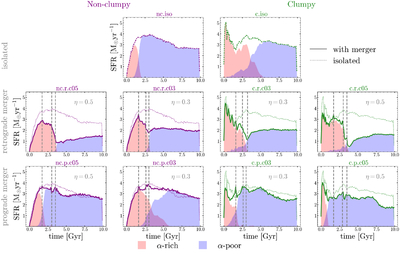
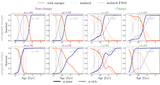
Caption: Figure 5.
The SFR of the disk, 4 < R/kpc < 12, and ∣z∣ < 3 kpc. The solid line shows the case for the isolated models (top row), and for those with a retrograde (middle row) or prograde merger (bottom row). Purple and green titles correspond to nonclumpy and clumpy models. The contribution to the SFR from the α-rich and α-poor populations is represented by orange and blue areas, respectively. The models with a clear chemical bimodality have two main features: (i) a significant decrease in SFR and (ii) the SFR of the α-rich stars at earlier times is higher than the α-poor population at later times. These occur in the isolated clumpy models and the nonclumpy and clumpy models with a retrograde merger. A prograde merger, however, does not significantly reduce the α-poor SFR and fails to produce the chemical bimodality of the clumpy model. The vertical dashed lines indicate the time of the dwarf’s pericenter passages during the merger. The initial orbital circularity of the satellite, η, is indicated in each panel. The green and purple dotted lines show the SFR for the isolated clumpy and nonclumpy models, respectively.
Other Images in This Article
Copyright and Terms & Conditions
© 2026. The Author(s). Published by the American Astronomical Society.

