

Image Details
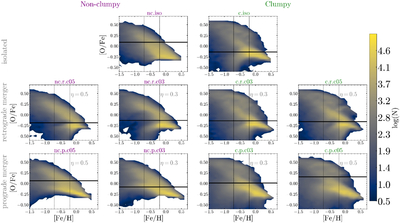
Caption: Figure 3.
Density in the [α/Fe]-[Fe/H] plane for the spatial range 4 < R/kpc < 12, and ∣z∣ < 3 kpc. All models share the same initial gas and dark matter distribution for the MW-like and dwarf galaxies. Clumpy and nonclumpy models are distinguished by titles colored in green and purple, respectively. Isolated, retrograde, and prograde models are shown in the first, second, and third rows, respectively. The satellite’s initial orbit circularity is set to 0.3 (second and third columns) or 0.5 (first and fourth columns). All the clumpy models, including the isolated one, develop a chemical bimodality in the disk. However, the prograde mergers do not create the bimodal chemical disk in the nonclumpy model, similar to the nonclumpy isolated model. In nonclumpy models, the bimodality arises primarily from the gas-rich merger, whereas in clumpy models, it is predominantly driven by star formation in the clumps. The black dashed lines show the [Fe/H] interval on which the [O/Fe] probability density function was built (see Figure 4) to separate both populations. The black solid horizontal line indicates the [O/Fe], which distinguishes the α populations (see Section 4.1).
Other Images in This Article
Copyright and Terms & Conditions
© 2026. The Author(s). Published by the American Astronomical Society.

