

Image Details
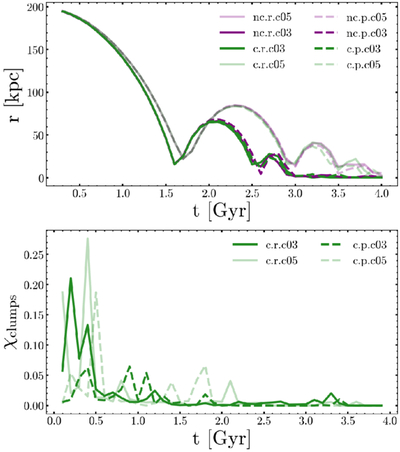
Caption: Figure 1.
Top: the orbital evolution of the satellite galaxy for all the merger models. Low and high supernova feedback models are shown by the green and purple lines, respectively. Prograde and retrograde mergers are represented by dashed and solid lines, respectively. While the subgrid physics and nature of the merger do not influence the orbital evolution, the initial orbital circularity does. More radial orbits (dark lines), η = 0.3, have two apocenters, and the pericenters happen at earlier times compared to the merger on a more circular orbit, η = 0.5. Bottom: the clump mass fraction evolution. The clumps, which only form in the low feedback regime, correspond to 10%–20% of the total disk mass in the first 0.5 Gyr; they cease to contribute at around t = 3 Gyr.
Other Images in This Article
Copyright and Terms & Conditions
© 2026. The Author(s). Published by the American Astronomical Society.

