

Image Details
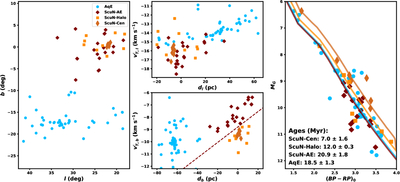
Caption: Figure 9.
Substructures in ScuN, with AqE for reference. We show l vs. b spatial coordinates at left. The expansion-corrected transverse velocity distribution in l and b are shown in the middle column. All three components are separated using some combination of space and velocity cuts. ScuN–Cen was identified by isolating a central clump, and the remaining stars were divided further with a linear cut in db vs. vT,b parameter space (indicated by the dashed line), splitting it into a larger halo around ScuN–Cen (ScuN–Halo), and a component that aligns with expansion from AqE (ScuN–AE). All three components are distinct in the CMD (right), where members of ScuN–Cen are consistently the youngest, followed by ScuN–Halo (with two outliers), and then ScuN–AE, which is consistent with AqE. The ages of subgroups are annotated, and the corresponding best-fit isochrones are shown with colors matching the markers.
Other Images in This Article
Copyright and Terms & Conditions
© 2026. The Author(s). Published by the American Astronomical Society.

