

Image Details
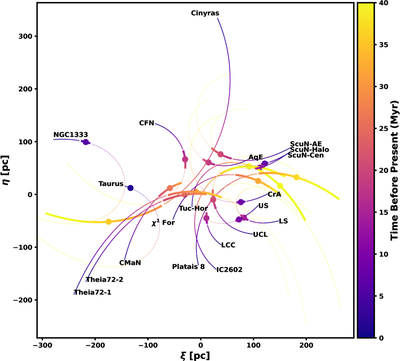
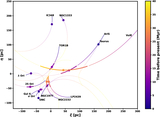
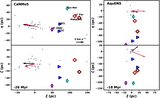
Caption: Figure 4.
Dynamical trace back of CMaN, Theia 72, AqE, ScuN, and literature associations that were comoving or cospatial with any of them at formation, showing divergence from a close configuration between 20 and 30 Myr ago to their widely distributed positions in the present day. Curves show the trajectories of populations colored by time, with dark colors for times closer to the present day, shown in ξ vs. η corotating Galactic coordinates (X–Y coordinates with the Galactic center locked to the right and centered on the local average). Dots indicate formation sites based on the best-fit age, with the thick bar around them indicating a 20% systematic age uncertainty. The lines are thin for times before this interval and thick after it, indicating the added uncertainty from inferring gas motions using stars. Typical velocity uncertainties are <0.5 km s−1 (SPYGLASS-IV-A), corresponding to a positional uncertainty of ∼0.5 pc Myr–1 before present. The divergence is centered on the Local Bubble, and components of CaNMoS (CMaN and Theia 72) and ScuN–Y (ScuN–Cen and –Halo) formed with largely outward velocities, consistent with formation on its edge, while AqE and ScuN–AE formed with inbound velocities, potentially through a collision between their progenitor cloud and that bubble.
Other Images in This Article
Copyright and Terms & Conditions
© 2026. The Author(s). Published by the American Astronomical Society.

