

Image Details
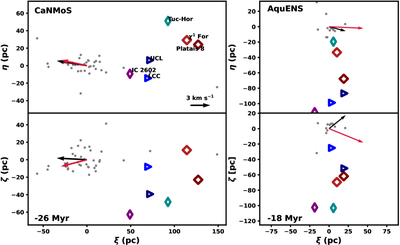
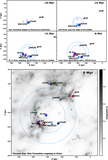
Caption: Figure 11.
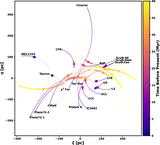
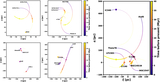
Positions of CaMNoS (left) and AquENS (right) members (gray) relative to their average at formation 26 and 18 Myr ago, respectively, plotted against early forming components of the Local Family (labeled in the first panel). We plot two velocity vectors originating from the average position of each low-mass association, with the black one corresponding to the direction of motion, measured against the average of the Local Bubble, and the velocity vector between the most widely separated subcomponent: Theia 72-1 and CMaN for CaNMoS, and AqE and ScuN–AE for AquENS. CaNMoS shows a velocity difference pointed away from the early components of the Local Family, consistent with a collision between material ejected from those populations and some interloping cloud. In AquENS, the velocity difference is oriented along the direction of motion in all directions but Z, suggesting that ScuN–AE inherited an outward velocity vector through an interaction with the Local Bubble.
Other Images in This Article
Copyright and Terms & Conditions
© 2026. The Author(s). Published by the American Astronomical Society.

