

Image Details
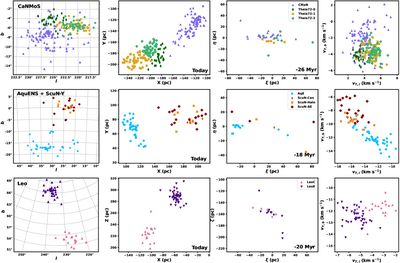
Caption: Figure 1.
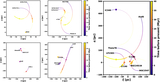
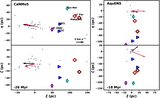
Pairs of low-mass stellar populations that form larger complexes: CaNMoS (CMaN + Theia 72; top), (AqE + ScuN; middle), and Leo (LeoE + LeoC; bottom). In the left column, we show their on-sky distributions in l vs. b Galactic coordinates. We then show their present-day distribution in X vs. Y Galactic coordinates in the second column, or X vs. Z coordinates for Leo, which separates more prominently in Z. In the third column, we show their distributions in Galactic Cartesian coordinates near the time of their formation after trace back, which contains fewer points due to the need for high-quality RVs. In CaNMoS and Leo, the distributions of the component populations at formation overlap. Across AqE and ScuN, the convergence is less clear, as only AquENS (AqE + ScuN–AE in ScuN) nearly overlap at formation. ScuN–Cen and ScuN–Halo are dynamically similar, but do not form a common star formation event with AqE. In the final column, we show the distributions of all three association pairs in transverse velocity, where velocity distributions for subcomponents consistently overlap.
Other Images in This Article
Copyright and Terms & Conditions
© 2026. The Author(s). Published by the American Astronomical Society.

