

Image Details
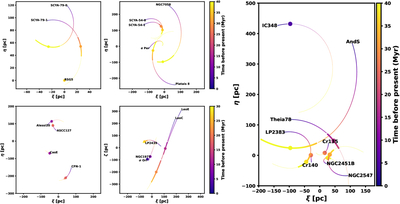
Caption: Figure 5.
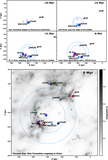
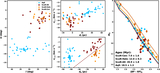
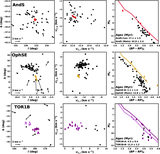
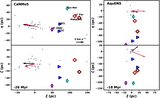
Same as Figure 4, but for the populations in our low-mass set outside the Local Family and Orion. In the top row at left, we show SCYA-79 (left) and SCYA-54 (right) relative to their comoving and cospatial sets, traced back 60 Myr and sharing the color bar on the right. In the bottom row at left, we show CasE (left) and the Leo Association (right), traced back 30 Myr and sharing the color bar on the right. At right, we show stellar populations cospatial or comoving with AndS or Theia 78 at formation, corresponding roughly to the Cr135 Family from C. Swiggum et al. (2024). Theia 78 formed outbound from that family, but with a notably non-RV, giving it an uncertain connection, while AndS has a velocity mismatch with the rest of the family that makes relatedness unlikely. SCYA-79 shows velocities and ages consistent with an origin in the Cinyras Association, and it is the only population in this set with a plausible connection to a literature population. All others show uncertain connections with other associations, although LeoE and LeoC have motions consistent with formation while entering a portion of the Galactic plane with known clouds.
Other Images in This Article
Copyright and Terms & Conditions
© 2026. The Author(s). Published by the American Astronomical Society.

