

Image Details
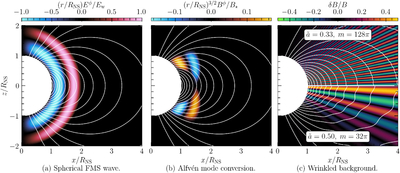
Caption: Figure 1.
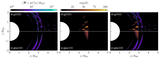
The three setups presented in this paper. Left: a spherical FMS wave, ﹩{E}^{\phi }={R}_{{\rm{NS}}}{E}_{{\rm{w}}}\sin (\omega t)/r﹩, is launched from the neutron star surface into a dipolar background magnetic field. Middle: toroidal A waves, ﹩{B}^{\phi }\propto {({R}_{{\rm{NS}}}/r)}^{3/2}﹩, of opposite polarity on either side of the equator, are launched through a localized twist on the stellar surface (Equation (6)). The waves collide at the equator producing a fast mode that propagates radially outward and shocks. Right: the initial background dipolar magnetic field is perturbed with a harmonic standing wave (Equation (8)), resulting in a wrinkled background. A fast mode is then launched from the stellar surface and interacts with this wave perturbation as it begins to shock. The ratio of wrinkle and background field, δB/B, is shown for two values of the wrinkle amplitude ﹩\tilde{a}﹩ and wavenumber m (Equation (8)). White lines show linearly spaced magnetic flux contours.
Other Images in This Article
Show More
Copyright and Terms & Conditions
© 2026. The Author(s). Published by the American Astronomical Society.

