

Image Details
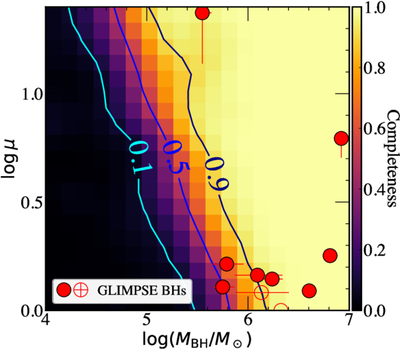
Caption: Figure A2.
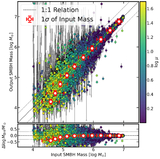
Completeness of broad Hα emission line detection. The colored contours denote 0.1, 0.5, and 0.9. It is noticed that at high-mass regime (MBH ≥ 106 M⊙), the broad Hα emission line can be detected with high completeness (near unity). In the intermediate-mass regime (105 < MBH < 106 M⊙), the broad Hα emission lines can be detected with the assistance of the gravitational lensing effect. A high magnification (μ) is necessary to detect BHs with lower masses (MBH < 105 M⊙). Our sources (red circles) are settled within a high-completeness regime.
Other Images in This Article
Show More
Copyright and Terms & Conditions
© 2026. The Author(s). Published by the American Astronomical Society.

Copyright ©
2026 Astronomy Image Explorer. All Rights Reserved.
