

Image Details
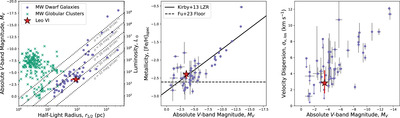
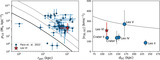
Caption: Figure 5.
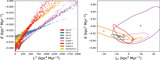
Left: the absolute V-band magnitude, MV, vs. the azimuthally averaged physical half-light radius, R1/2, of Leo VI and the population of known Local Group globular clusters and dwarf galaxies. Leo VI’s morphological properties are consistent with those of a dwarf galaxy. Middle: the systemic metallicity, [Fe/H], vs. the absolute V-band magnitude of Leo VI and the population of Local Group dwarf galaxies. The overlaid black line represents the V-band absolute luminosity–metallicity relation (“LZR”) found in E. N. Kirby et al. (2013), while the dashed black line represents the metallicity floor of [Fe/H] = −2.61 proposed for faint systems (S. W. Fu et al. 2023) Right: the line-of-sight velocity dispersion, σv,los, vs. absolute V-band magnitude of the population of Local Group dwarf galaxies.
Other Images in This Article
Show More
Copyright and Terms & Conditions
© 2025. The Author(s). Published by the American Astronomical Society.

