Image Details

Choose export citation format:

A Pride of Satellites in the Constellation Leo? Discovery of the Leo VI Milky Way Satellite Ultra-faint Dwarf Galaxy with DELVE Early Data Release 3

  • Authors: C. Y. Tan, W. Cerny, A. Drlica-Wagner, A. B. Pace, M. Geha, A. P. Ji, T. S. Li, M. Adamów, D. Anbajagane, C. R. Bom, J. A. Carballo-Bello, J. L. Carlin, C. Chang, A. Chaturvedi, A. Chiti, Y. Choi, M. L. M. Collins, A. Doliva-Dolinsky, P. S. Ferguson, R. A. Gruendl, D. J. James, G. Limberg, M. Navabi, D. Martínez-Delgado, C. E. Martínez-Vázquez, G. E. Medina, B. Mutlu-Pakdil, D. L. Nidever, N. E. D. Noël, A. H. Riley, J. D. Sakowska, D. J. Sand, J. Sharp, G. S. Stringfellow, C. Tolley, D. L. Tucker, A. K. Vivas

C. Y. Tan et al 2025 The Astrophysical Journal 979 .

  • Provider: AAS Journals

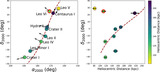
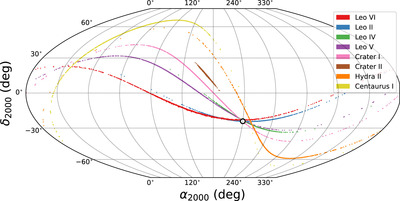
Caption: Figure 10.

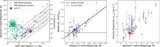
Distribution of the possible orbital poles of Leo VI and the other possible members of the Crater-Leo infall group. The position of the orbital pole of Leo VI is consistent with the possible group orbital pole of the Crater-Leo group (Leo II, Leo IV, Leo V, and Crater) at (αJ2000, δJ2000) ∼ (210°, −24°), while the position of the orbital pole of Crater II is inconsistent with the group orbital pole.

Other Images in This Article
Show More

Copyright and Terms & Conditions

Additional terms of reuse