

Image Details
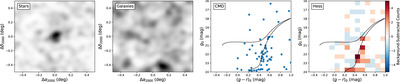
Caption: Figure 1.
Diagnostic plots for Leo VI constructed with the deeper follow-up DECam photometric data. Left: smoothed isochrone-filtered spatial density of stars in the region around the Leo VI. The system appears as a significant overdensity against a relatively constant background. Center left: smoothed isochrone-filtered spatial density of galaxies. Center right: CMD of stars that are within 4﹩^{\prime} ﹩ of the centroid of the system. Right: color–magnitude Hess diagram of the foreground stars within 4﹩^{\prime} ﹩ of the centroid of Leo VI minus the background stars in a concentric annulus with radius from 12﹩^{\prime} ﹩ to 12﹩\mathop{.}\limits^{{\rm{^{\prime} }}}﹩65. We use the Ultrafaint GAlaxy LIkelihood (ugali) best-fit old (τ ∼ 13.3 Gyr), metal-poor (Z = 0.0001, [Fe/H] ∼ −2.2) PARSEC isochrone with a distance modulus of (m − M)0 = 20.2 for this figure.
Other Images in This Article
Show More
Copyright and Terms & Conditions
© 2025. The Author(s). Published by the American Astronomical Society.

