

Image Details
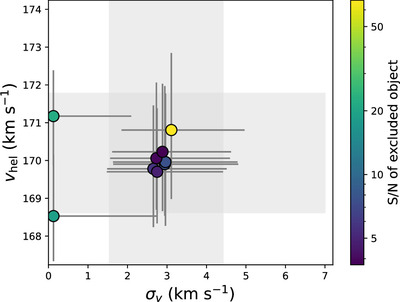
Caption: Figure 4.
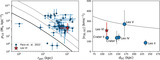
Jackknife test for the radial velocity parameters of Leo VI. The gray regions represent the 68% percentile uncertainty of the parameters obtained from the full sample. Each point represents the parameters obtained using a subsample that has excluded one star. The velocity dispersion measurement of the system becomes unresolved when we remove either one of the two very-high-S/N stars (S/N > 15) with a large difference in line-of-sight velocity between each other (vhel = 164.6 ± 1.6 and 174.0 ± 1.7 km s−1).
Other Images in This Article
Show More
Copyright and Terms & Conditions
© 2025. The Author(s). Published by the American Astronomical Society.

Copyright ©
2026 Astronomy Image Explorer. All Rights Reserved.
