

Image Details
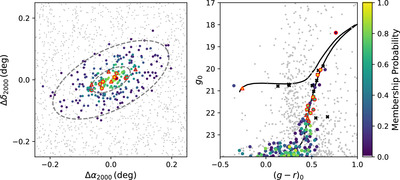
Caption: Figure 2.
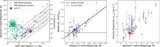
Left: map of likely member stars in the vicinity of the Leo VI system, with stars colored by their ugali membership probability. Stars with a lower ugali membership probability (p < 0.05) are shown in gray. Right: CMD of likely member stars in the system, again colored by their ugali membership probability. In both plots, stars with a red outline represent spectroscopically confirmed member stars (circles) and candidate member stars (triangles) of Leo VI (Section 5). The black crosses denotes sources that have confirmed to be nonmembers of Leo VI either through their inconsistent spectroscopic radial velocity, high Gaia proper motion, or Gaia classification as likely quasi-stellar objects. The black curve represents the ugali best-fit PARSEC isochrone (τ ∼ 13.3 Gyr, Z = 0.0001, and (m − M)0 = 20.2).
Other Images in This Article
Show More
Copyright and Terms & Conditions
© 2025. The Author(s). Published by the American Astronomical Society.

