

Image Details
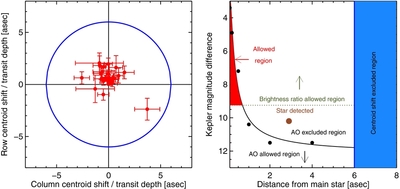
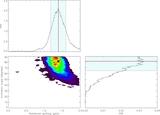
Caption: Figure 2.
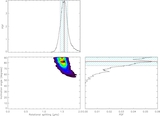
Left-hand panel: centroid shifts during transits divided by the transit depth for each candidate during each SC quarter. This is an estimate of the distance between the source of the transit signal and the center of light of the system. Based on these data the transit signal must originate from within a 6 arcsec radius (blue circle; see text). Right-hand panel: parameter space for the possible blend scenarios. Plotted on the abscissa is the distance from the center of light in the aperture, and on the ordinate the difference in magnitude with respect to Kepler-65. In addition to the centroid-shift-excluded region (blue), any star just over 9 mag fainter than Kepler-65 is excluded because it would not contribute enough light on the aperture to produce the observed transit depths. This limit is marked by the horizontal dotted line, which was computed assuming an eclipse depth of 50%. The AO imaging excludes the region above the continuous black line, which was obtained by extrapolation of a best-fitting hyperbolic function, fitted to the limits (black dots) given in Table 2 of Adams et al. (2012). Only the red region is still allowed; in this sense the "radius of confusion" is 0.7 arcsec.
Other Images in This Article

Copyright and Terms & Conditions
© 2013. The American Astronomical Society. All rights reserved.

