

Image Details
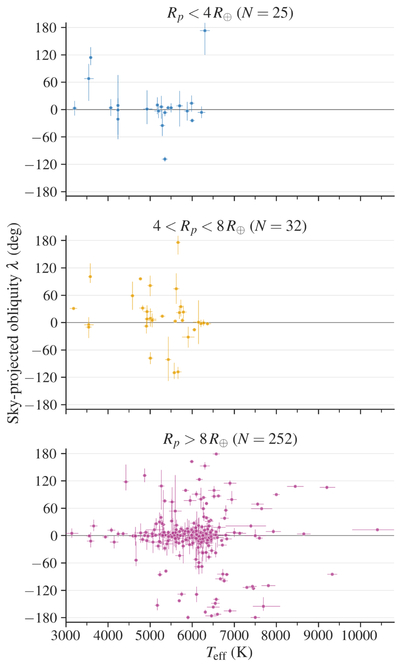
Caption: Figure 1.
Sky-projected stellar obliquity λ as a function of host-star effective temperature for planets with orbital periods P < 100 days. From top to bottom, the panels show systems with Rp < 4 R⊕, 4 R⊕ < Rp < 8 R⊕, and Rp > 8 R⊕. The obliquities, stellar effective temperatures, orbital periods, and published planetary radii are compiled from TEPCat (J. Southworth 2026); the horizontal and vertical error bars show the cataloged uncertainties in Teff and λ, respectively, where available. This is a heterogeneous compilation rather than a uniformly selected sample, and the measurements differ in precision and reliability. Accordingly, this figure is intended to illustrate the current state of the available measurements, rather than to support a statistical inference about the underlying obliquity distributions. The giant-planet sample spans a wide range of obliquities but also shows a pronounced concentration of aligned systems near λ = 0∘, extending up to Teff ∼ 6500 K (X.-Y. Wang et al. 2026).
Other Images in This Article
Copyright and Terms & Conditions
© 2026. The Author(s). Published by the American Astronomical Society.

