

Image Details
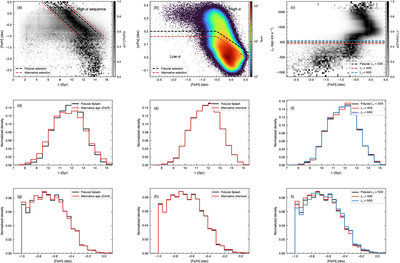
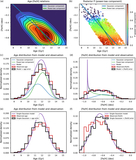
Caption: Figure C1.
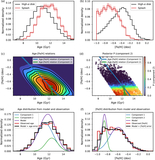
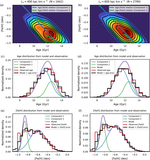
Robustness tests of the selection of the Splash population. (a) Conditional probability distribution of age at a given [Fe/H], p(τ∣[Fe/H]), for the high-α disk stars, normalized to the peak value at each [Fe/H] bin. The black and red dashed lines denote the fiducial and broadened age–[Fe/H] selection boundaries, respectively. (b) Number-density distribution of sample stars in the [Fe/H]–[α/Fe] plane. The black and red dashed lines show the fiducial and alternative chemical criteria, respectively, for separating high- and low-α stars. (c) Row-normalized stellar density of sample stars in the [Fe/H]–Lz plane, corresponding to p([Fe/H]∣Lz). The horizontal dashed lines indicate the fiducial Lz < 500 kpc km s−1 cut (black) and the alternative cuts of Lz < 400 and <600 kpc km s−1 (red and blue, respectively). Panels (d)–(f) show the selection-corrected normalized age distributions, while panels (g)–(i) show the selection-corrected normalized metallicity distributions, of the resulting Splash samples. In panels (d) and (g), the red curves correspond to the broader age–[Fe/H] selection; in panels (e) and (h), they correspond to the alternative chemical criterion; and in panels (f) and (i), they show the samples selected with Lz < 400 and <600 kpc km s−1. The black curves show the fiducial Splash sample.
Other Images in This Article
Copyright and Terms & Conditions
© 2026. The Author(s). Published by the American Astronomical Society.

