

Image Details
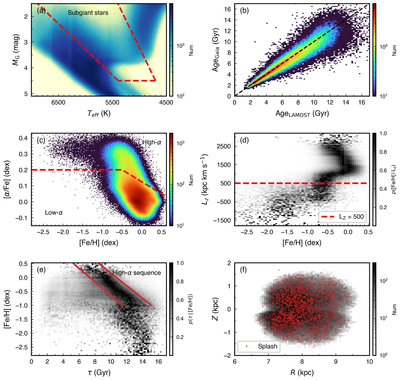
Caption: Figure 1.
(a) Illustration of the subgiant selection in the Teff–MG diagram for stars with metallicities in the range −0.1 < [Fe/H] < 0.1. The two red dashed lines show the metallicity-dependent selection boundaries evaluated at solar metallicity, while the horizontal red dashed line marks the additional cut at MG = 4.5. Selected subgiants lie between the two sloping boundaries and satisfy MG < 4.5. (b) Comparison of age and [Fe/H] estimates for ∼110,000 stars in common between the Gaia DR3 subgiant sample and the LAMOST Data Release 7 subgiant sample of M. Xiang & H.-W. Rix (2022). The black line represents the 1:1 line. (c) Number-density distribution of sample stars in [Fe/H]–[α/Fe] space. The red dashed line separates the sample into high- and low-α regimes. (d) The row-normalized stellar density of sample stars in [Fe/H]–Lz space. The horizontal dashed line marks Lz = 500 kpc km s−1. (e) Probability distribution of stellar age p(τ∣[Fe/H]), normalized to the peak value for each [Fe/H], for high-α stars with Lz < 1500 kpc km s−1 in the Gaia DR3 subgiant sample. The red boundaries delineate the parameter window in age–[Fe/H] space where the high-α disk is expected to dominate. (f) Spatial distributions, in Galactocentric cylindrical coordinates R–Z, of the high-α disk (grayscale density map) and Splash (red points) populations selected from panel (e).
Other Images in This Article
Copyright and Terms & Conditions
© 2026. The Author(s). Published by the American Astronomical Society.

