

Image Details
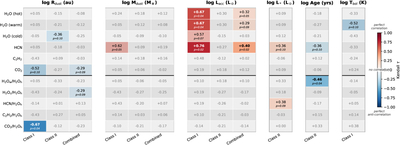
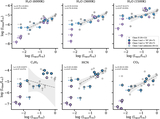
Caption: Figure 9.
Generalized Kendall τ correlation coefficients between slab model molecular properties and disk/stellar properties. Each panel corresponds to a different disk/stellar property: dust radius (Rdust), dust mass (Mdust), accretion luminosity (Lacc), stellar luminosity (L⋆), and stellar age. The first three panels show results for the Class I, Class II, and combined samples separately; the stellar luminosity and age panels show Class II only. Rows are divided into absolute slab model masses (top) and mass ratios relative to hot water (bottom). Cell color encodes the Kendall τ (blue = negative, red = positive), with the p-value annotated in each cell. Colored cells denote correlations significant at the p < 0.05 level (full saturation, bold text) or marginally significant at p < 0.1 (faded color); gray cells indicate no significant correlation. Upper limits on molecular masses and accretion luminosities are included as censored data.
Other Images in This Article
Show More
Copyright and Terms & Conditions
© 2026. The Author(s). Published by the American Astronomical Society.

