

Image Details
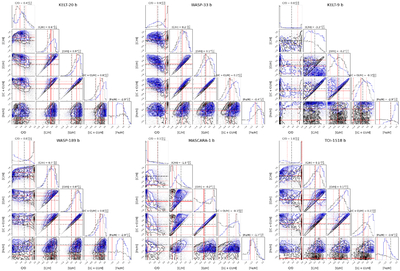
Caption: Figure 8.
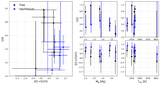
Derived posteriors for the C/O ratio, carbon and oxygen abundances, total volatile abundance, and iron abundance. Median and ±34% confidence intervals are indicated in solid and dotted red, respectively, and the solar values are shown in dashed–dotted black. The black distribution is computed from the free retrieval, and the blue distribution from the equilibrium retrieval. The retrieved carbon and oxygen abundances are generally consistent with solar to supersolar volatile abundances, but have very large uncertainties that extend from subsolar values to the upper end of the mean molecular weight prior. The Fe abundances are at best weak upper limits. The retrieved C/O ratios are bimodal, preferring either zero or one depending on whether the retrieval prefers low H2O abundances dissociating at high altitudes, resulting in a high C/O, or high H2O abundances and deep dissociation, resulting in a low C/O. The actual retrieved spectra are similar despite the range of C/O ratios, indicating that our retrievals are not reliably measuring the bulk composition of these UHJ atmospheres.
Other Images in This Article
Show More
Copyright and Terms & Conditions
© 2026. The Author(s). Published by the American Astronomical Society.

