

Image Details
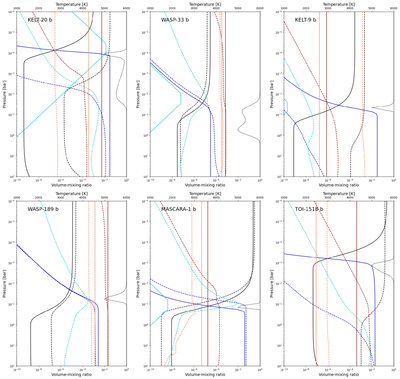
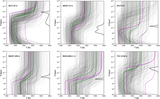
Caption: Figure 7.
Retrieved maximum-likelihood P−T profiles (black) and VMRs for H2O (blue), CO (dark red), OH (cyan), and Fe (light orange) for all targets. The free retrievals are shown as solid lines while the equilibrium retrievals are shown as dashed lines. The gray lines at the right show the wavelength-median emission contribution function. KELT-9 b shows the largest discrepancy between the retrievals, with the equilibrium case preferring an atmosphere dominated by Fe features, and the free retrieval preferring strong H2O, despite the high temperature of KELT-9 b. For WASP-33 b and WASP-189 b, the equilibrium and free retrievals are in good agreement, though the free retrieval does not support significant OH. For KELT-20 b, the equilibrium case prefers a higher temperature and smaller P−T contrast than the free retrieval, leading to significantly different mixing profiles, but both cases support the presence of H2O, CO, and OH, in similar relative quantities. In MASCARA-1 b, the free retrieval appears to be underestimating the deep CO abundance due to neglecting CO dissociation, but the H2O profiles are in good agreement. For TOI-1518 b, the retrievals differ significantly, likely because the atmospheric detection is dominated by CO alone and a wide range of P−T profiles and abundances can produce a CO-dominated spectrum.
Other Images in This Article
Show More
Copyright and Terms & Conditions
© 2026. The Author(s). Published by the American Astronomical Society.

