

Image Details
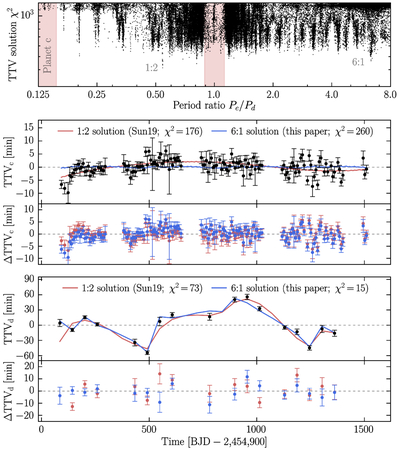
Caption: Figure 6.
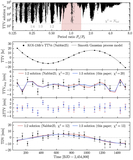
Kepler-411. Top panel: χ2 vs. period ratio (Ndof = 435). Many solutions provide a good fit to the data, but most involve implausible planet densities, large eccentricities, or grossly misaligned orbits. The 1:2 and 6:1 solutions seem most plausible. Second panel: Planet c’s TTVs from L. Sun et al. (2019) with inflated uncertainties (see Section 3.6). The red curve shows the best variant of the 1:2 solution (L. Sun et al. 2019), and the blue curve shows the 6:1 solution. Third panel: Planet c’s residuals for the 1:2 solution (rms = 2.4 minutes) and the 6:1 solution (rms = 2.8 minutes). Fourth panel: Planet d’s TTVs from L. Sun et al. (2019) with inflated uncertainties, along with the 1:2 and 6:1 models. Fifth panel: planet d’s residuals for the 1:2 solution (rms = 11.5 minutes) and the 6:1 solution (rms = 5.5 minutes). Planet b’s flat TTVs were included in the fit but have been omitted from this figure. The Δχ2 formally favors the 1:2 solution, but stellar activity and uncertain timing uncertainties make this preference questionable.
Other Images in This Article
Show More
Copyright and Terms & Conditions
© 2026. The Author(s). Published by the American Astronomical Society.

