

Image Details
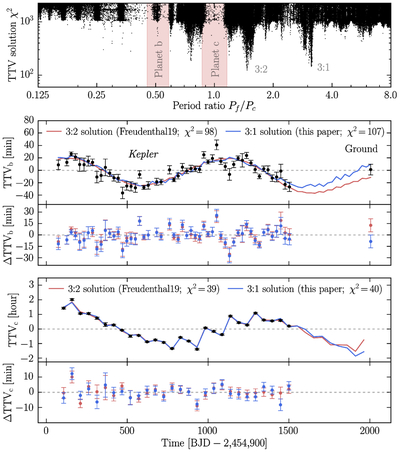
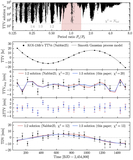
Caption: Figure 5.
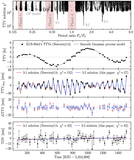
Kepler-82. Top panel: χ2 vs. period ratio (Ndof = 61). The 3:2 and 3:1 solutions provide the best fit to the data. Second panel: Planet b’s TTVs from Kepler and ground-based follow-up, as measured in this work. The red curve shows the best variant of the 3:2 solution (J. Freudenthal et al. 2019), and the blue curve shows the 3:1 solution. Third panel: Planet b’s residuals for the 3:2 solution (rms = 9.1 minutes) and the 3:1 solution (rms = 9.6 minutes). Fourth panel: Planet c’s TTVs, as measured from this work, along with the 3:2 and 3:1 models. Fifth panel: Planet c’s residuals for the 3:2 solution (rms = 3.7 minutes) and the 3:1 solution (rms = 4.2 minutes). The 3:2 solution provides a minor improvement, with Δχ2 = 10, but the timing uncertainties are likely to be underestimated. The differences are too slim to conclusively identify the correct solution.
Other Images in This Article
Show More
Copyright and Terms & Conditions
© 2026. The Author(s). Published by the American Astronomical Society.

