

Image Details
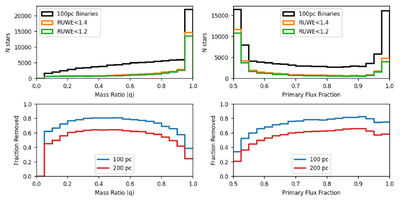
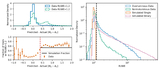
Caption: Figure 2.
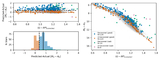
Results of different RUWE cuts for low-mass stars from a simulated set of 200,000 binaries. The predicted RUWE parameters were generated using the GAIAUNLIMITED (T. Cantat-Gaudin et al. 2023; A. Castro-Ginard et al. 2023) package. A linear interpolation was used to relate mass and absolute magnitude from M. J. Pecaut & E. E. Mamajek (2013). Left panels: The top panel displays the mass ratio distribution of our simulation, as found by K. El-Badry et al. (2019). The resulting mass ratio distributions from two RUWE limits, 1.4 in orange and 1.2 in green, are also shown. The bottom panel shows the fraction of stars removed at a given mass ratio for different distance limits using the constraint RUWE< 1.2, which we adopt in Section 2. Right panels: distribution (top panel) and fraction of stars removed (bottom panel) for a given primary flux fraction for the full sample and the stars below the RUWE thresholds. The primary flux fraction is defined as the amount of flux emitted from the system that comes from the brighter star. The RUWE cuts are less effective at removing the equal-mass systems (∼0.5) and effectively single stars (∼1.0).
Other Images in This Article
Show More
Copyright and Terms & Conditions
© 2026. The Author(s). Published by the American Astronomical Society.

