

Image Details
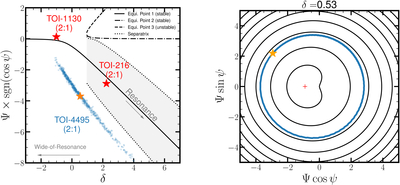
Caption: Figure 7.
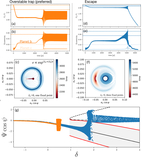
Hamiltonian of first-order MMR, adapted from D. Nesvorný & D. Vokrouhlický (2016). Left: location of fixed points (solid, dashed, and dotted–dashed lines) and separatrix (dotted lines) as a function of δ, a parameter that measures the proximity to resonance. ψ is the resonant angle, and its conjugate momentum, Ψ, scales with the combined eccentricity of planets. Resonant orbits, shown as a shaded area and enclosed by the separatrix, exist in δ > 0.95. Blue points are the posterior of TOI-4495 from the photodynamics analysis, which has ﹩\delta =0.{4}_{-0.7}^{+1.9}﹩. Orange star is the best-fit solution. We also show the resonant TOI-216 and near-resonant TOI-1130 for comparison. Right: phase space at δ = 0.53. The blue trajectory is the integrated orbit of the best-fit solution (orange star in the left figure), which suggests a circulating solution. The red cross is the stable equilibrium point (solid line on the left).
Other Images in This Article
Copyright and Terms & Conditions
© 2026. The Author(s). Published by the American Astronomical Society.

