

Image Details
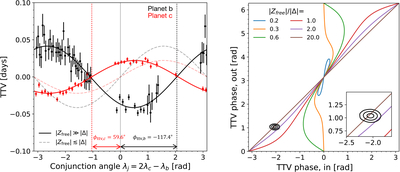
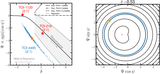
Caption: Figure 3.
Left: TTVs of planet b (black) and planet c (red) phased to the conjunction angle λj = 2λc–λb. If the free eccentricity Zfree is small compared to Δ, no TTV phase shift is expected (dashed lines; TTV = 0 when λj = 0), which is inconsistent with the observations (solid lines). We measure TTV phases (vertical dotted lines) of ﹩{\phi }_{b}=-117.4\pm 3\mathop{.}\limits^{^\circ }5﹩ and ﹩{\phi }_{c}=59.5\pm 2\mathop{.}\limits^{^\circ }2﹩ for planets b and c, respectively. Right: TTV phases of two planets near the 2:1 MMR. Colored curves show theoretical TTV phases for different values of Zfree. When Zfree is comparable to or larger than Δ, nonzero TTV phases arise. The TTV phase posteriors are shown as contours corresponding to the 1σ, 2σ, and 3σ credible levels. For TOI-4495, the TTV data favor ∣Zfree∣ values larger than Δ by a factor of a few. See Section 5.2 for further discussion.
Other Images in This Article
Copyright and Terms & Conditions
© 2026. The Author(s). Published by the American Astronomical Society.

