

Image Details
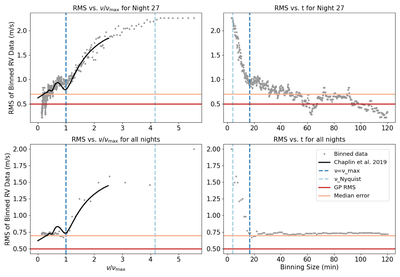
Caption: Figure 12.
Illustration of how RV rms decreases as we bin the RVs with changing bin sizes. The x-axes of the left panels are the lengths of the bin in units of ﹩{\nu }_{{\rm{\max }}}﹩, which is 17.14 minutes (Table 1), and the x-axes of the right panels are bin sizes in minutes. The top panels are for night 27 data only, while the lower panels are for the entire RV dataset. The gray dots represent the RV rms for each bin size. The lower panels have fewer bins due to the short baselines in nights 2–26. The vertical dashed lines indicate the Nyquist frequency of our RV data (light blue) and ﹩{\nu }_{{\rm{\max }}}﹩ (dark blue). The horizontal lines mark the rms level after subtracting the stellar jitter signal derived from GP modeling from the original data (red) and the median error of the RV dataset (orange). The black solid line denotes the predicted relation from Figure 3 of W. J. Chaplin et al. (2019), stretched and shifted to match our data for illustration purposes. See Section 5.3 for more details.
Other Images in This Article
Show More
Copyright and Terms & Conditions
© 2026. The Author(s). Published by the American Astronomical Society.

