

Image Details
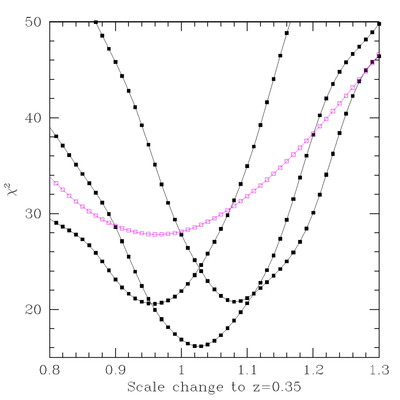
Caption: Fig. 6.
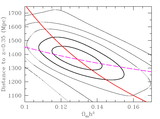
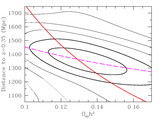
The χ2 values of the models as a function of the dilation of the scale of the correlation function. This corresponds to altering DV(0.35) relative to the baseline cosmology of ﹩\Omega =0.3﹩, ﹩\Omega _{\Lambda }=0.7﹩, and ﹩h=0.7﹩. Each line (save the magenta line) in the plot is a different value of Ωmh2, 0.11, 0.13, and 0.15 from left to right; ﹩\Omega _{b}h^{2}=0.024﹩ and ﹩n=0.98﹩ are used in all cases. The amplitude of the model has been marginalized over. The best‐fit χ2 is 16.1 on 17 degrees of freedom, consistent with expectations. The magenta line shows the pure CDM model with ﹩\Omega _{m}h^{2}=0.10﹩; it has a best χ2 of 27.8, which is rejected at 3.4 σ. Note that this curve is also much broader, indicating that the lack of an acoustic peak makes the scale less constrainable.
Other Images in This Article
Show More
Copyright and Terms & Conditions
© 2005. The American Astronomical Society. All rights reserved. Printed in U.S.A.

