Image Details

Choose export citation format:

Detection of the Baryon Acoustic Peak in the Large‐Scale Correlation Function of SDSS Luminous Red Galaxies

  • Authors: Daniel J. Eisenstein, Idit Zehavi, David W. Hogg, Roman Scoccimarro, Michael R. Blanton, Robert C. Nichol, Ryan Scranton, Hee-Jong Seo, Max Tegmark, Zheng Zheng, Scott F. Anderson, Jim Annis, Neta Bahcall, Jon Brinkmann, Scott Burles, Francisco J. Castander, Andrew Connolly, Istvan Csabai, Mamoru Doi, Masataka Fukugita, Joshua A. Frieman, Karl Glazebrook, James E. Gunn, John S. Hendry, Gregory Hennessy, Zeljko Ivezić, Stephen Kent, Gillian R. Knapp, Huan Lin, Yeong-Shang Loh, Robert H. Lupton, Bruce Margon, Timothy A. McKay, Avery Meiksin, Jeffery A. Munn, Adrian Pope, Michael W. Richmond, David Schlegel, Donald P. Schneider, Kazuhiro Shimasaku, Christopher Stoughton, Michael A. Strauss, Mark SubbaRao, Alexander S. Szalay, István Szapudi, Douglas L. Tucker, Brian Yanny, and Donald G. York

Eisenstein et al. 2005 The Astrophysical Journal 633 560.

  • Provider: AAS Journals

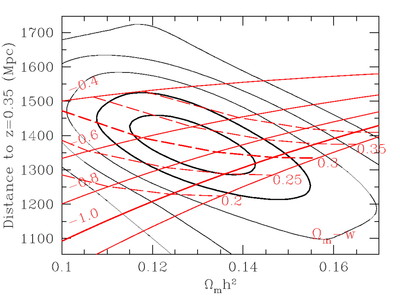
Caption: Fig. 10.

(a) Same as Fig. 7, but overplotted with model predictions from constant‐w flat models. For a given value of Ωmh2 and w, the angular scale of the CMB acoustic peaks (known to 1%) determines Ωm and H0. Of course, the required Ωm is a function of w and Ωmh2. The solid red lines show lines of constant w; the dashed red lines show lines of constant Ωm. Our knowledge of Ωmh2 still limits our inference of w. (b) Same as (a), but the dashed red lines are now lines of constant H0.
Other Images in This Article
Show More

Copyright and Terms & Conditions