

Image Details
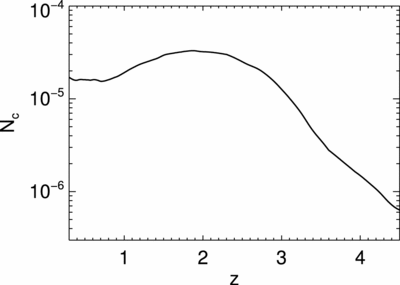
Caption: Fig. 9.
Expected mean number of companions per quasar with proper transverse separation ﹩5\ h^{-1}\ \mathrm{kpc}\,< R_{\mathrm{prop}\,}< 50\ h^{-1}\ \mathrm{kpc}\,﹩ and velocity difference ﹩\vert \Delta v\vert < 2000\ \mathrm{km}\,\ \mathrm{s}\,^{-1}﹩, as a function of redshift calculated from eq. [16], which assumes that the large‐scale quasar correlation function can be extrapolated as a power law to small scales. We used the correlation function parameters ﹩\gamma =1.53﹩ and ﹩r_{0}=4.8\ h^{-1}\ \mathrm{Mpc}\,﹩ measured by PMN04 from the 2dF quasar survey. A perfect survey, with no sources of incompleteness, is assumed. In a sample of ~50,000 quasars, the predicted number of binaries with ﹩5\ h^{-1}\ \mathrm{kpc}\,< R< 50\ h^{-1}\ \mathrm{kpc}\,﹩ is ~1. However, our clustering sample already contains 20 quasars with transverse separations this small, which is compelling evidence for excess clustering over what is expected from extrapolating the correlation function.
Other Images in This Article
Show More
Copyright and Terms & Conditions
© 2006. The American Astronomical Society. All rights reserved. Printed in U.S.A.

