

Image Details
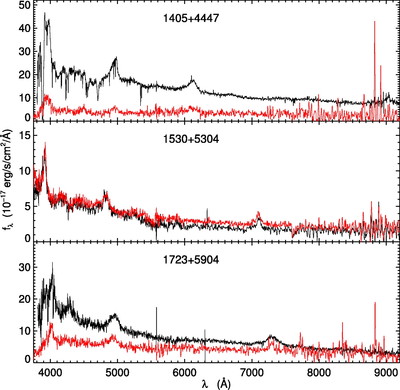
Caption: Fig. 7.
SDSS and APO spectra of both members of three binary quasars. The top panel shows the binary SDSS J1405+4447 (﹩z=2.23﹩, ﹩\Delta \theta =7\farcs 4﹩, ﹩R=142.8\ h^{-1}\ \mathrm{kpc}\,﹩), the middle panel shows SDSS J1530+5304 (﹩z=1.53﹩, ﹩\Delta \theta =4\farcs 1﹩, ﹩R=63.3\ h^{-1}\ \mathrm{kpc}\,﹩), and the bottom panel shows SDSS J1723+5904 (﹩z=1.60﹩, ﹩\Delta \theta =3\farcs 7﹩, ﹩R=59.0\ h^{-1}\ \mathrm{kpc}\,﹩). The binary in the middle panel is a member of the photometric sample, and both spectra were taken at APO. In the other two panels, the black curves are SDSS spectra of the brighter quasar in the pair, and the red curves are the APO spectra of the fainter companion. Deep imaging of SDSS J1405+4447 and SDSS J1723+5904 shows no lens in the foreground. The absorption features at 7600 Å are telluric.
Other Images in This Article
Show More
Copyright and Terms & Conditions
© 2006. The American Astronomical Society. All rights reserved. Printed in U.S.A.

